Comment savoir si une chaussure est antidérapante : un guide simple pour les chaussures du quotidien
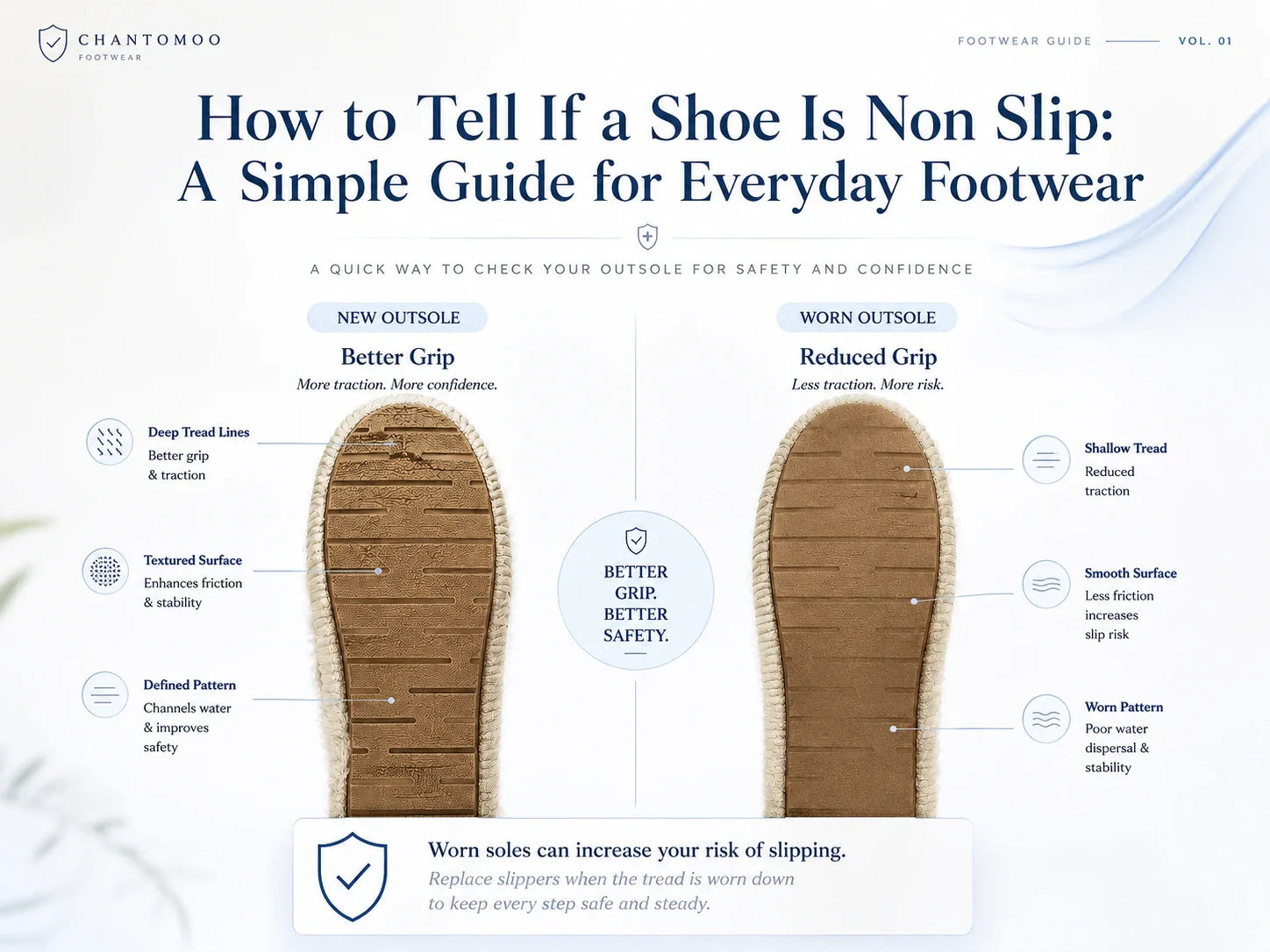


Lorsque vous achetez des chaussures ou des chaussons, le confort est généralement la première chose que vous remarquez. Mais le dessous de la chaussure compte aussi.
Une tige souple et une semelle intérieure rembourrée peuvent être très agréables, mais si la semelle extérieure est complètement lisse, fortement usée ou mal adaptée au sol sous vos pieds, la chaussure peut sembler moins stable sur le carrelage, le bois, le stratifié, les sols de cuisine ou d’autres surfaces lisses.
Alors, comment savoir si une chaussure est antidérapante ? Commencez par examiner la texture de la semelle extérieure, le motif de la semelle, le matériau de la semelle, l’ajustement général et les signes d’usure. Ces vérifications simples ne remplacent pas les tests professionnels, mais elles peuvent vous aider à faire un choix plus éclairé pour un usage quotidien.
Remarque importante sur l’adhérence
Aucune chaussure ne peut empêcher les glissades dans toutes les conditions. L’adhérence peut varier selon le sol, l’humidité, l’huile, la poussière, l’usure de la semelle extérieure, l’ajustement et votre façon de marcher. C’est pourquoi « antidérapant » ou « conçu pour une adhérence au quotidien » est généralement plus exact que de promettre qu’une chaussure est totalement antidérapante.
Retournez la chaussure et examinez la semelle extérieure. Une chaussure offrant une meilleure adhérence au quotidien présente généralement des rainures visibles, une texture en relief, une semelle flexible et un dessous qui ne semble pas complètement plat, brillant ou poli.
Les principaux éléments à vérifier sont les suivants :
La semelle extérieure est le premier élément à examiner. Une chaussure conçue pour offrir une meilleure adhérence au quotidien présente généralement une certaine texture plutôt qu’une semelle totalement plate et polie.
Recherchez notamment les détails suivants :
Une semelle extérieure complètement lisse peut offrir moins d’adhérence sur les sols intérieurs durs, surtout lorsque la surface devient poussiéreuse ou usée.

La semelle extérieure est le motif moulé sous la chaussure. Son rôle est d’aider la semelle à interagir avec la surface de marche.
Pour les chaussons d’intérieur de tous les jours, vous n’avez généralement pas besoin de crampons profonds et agressifs comme ceux des chaussures de randonnée ou des chaussures de travail pour l’extérieur. De petites rainures, des motifs ondulés, une texture géométrique ou des zones de contact séparées peuvent être plus adaptés aux chaussures légères pour la maison.
La semelle la mieux adaptée dépend de l’endroit où la chaussure sera portée. Un chausson confortable pour la maison est conçu pour un environnement très différent de celui d’une cuisine de restaurant, d’un hôpital, d’un entrepôt ou d’un chantier.
| Type de chaussure | Semelle extérieure typique | Environnement prévu |
|---|---|---|
| Chaussons d’intérieur | Rainures légères ou zones texturées | Sols domestiques secs et port bref au quotidien |
| Chaussures de marche | Sculpture plus marquée au niveau du talon et de l’avant-pied | Trottoirs et marche quotidienne en extérieur |
| Chaussures de randonnée | Crampons multidirectionnels plus profonds | Sentiers, terre, rochers et surfaces extérieures irrégulières |
| Chaussures de travail professionnelles | Compositions et sculptures de semelle extérieure adaptées à l’environnement | Lieux de travail humides, huileux, commerciaux ou industriels |
La forme de la sculpture n’est qu’un élément parmi d’autres. Le matériau de la semelle influence également la sensation de la chaussure contre le sol.
Un dessous très dur, brillant et semblable à du plastique peut sembler glissant sur certaines surfaces lisses. Une semelle extérieure légèrement plus souple ou plus flexible peut procurer une sensation de stabilité accrue au quotidien, même si le matériau seul ne garantit pas la résistance au glissement.
De nombreux chaussons d’intérieur utilisent de l’EVA léger, car ce matériau est souple et confortable pour un usage quotidien en intérieur. Lors de l’évaluation de chaussons en EVA, recherchez une texture moulée ou des rainures plutôt que de vous fier uniquement au nom du matériau.
L’adhérence ne dépend pas uniquement de la semelle extérieure. Une chaussure peut présenter une sculpture visible tout en semblant instable si elle est trop lâche, glisse du talon ou bouge sous le pied.
Un ajustement quotidien plus sûr devrait :
Pour les chaussons, une tige réglable peut être utile, car elle permet de rendre l’ajustement sur le dessus du pied plus ou moins serré.
Dès que vous recevez une nouvelle paire, vous pouvez effectuer une vérification prudente au quotidien sur un sol intérieur propre et sec.
Ne testez jamais délibérément des chaussures sur un sol mouillé, huileux, savonneux, verglacé ou autrement dangereux. Une vérification prudente sur sol sec peut vous aider à évaluer la sensation au quotidien, mais il ne s’agit pas d’un test professionnel de résistance au glissement.
Même une chaussure qui semblait autrefois bien stable peut devenir plus lisse avec une usure régulière.
Examinez régulièrement la semelle extérieure et envisagez de remplacer les chaussures ou les chaussons lorsque :
De la saleté et de la poussière peuvent également s’accumuler dans les rainures de la semelle. Nettoyer la semelle extérieure conformément aux instructions d’entretien du produit peut aider à rétablir un contact normal avec le sol, mais cela ne peut pas remplacer une sculpture qui s’est physiquement usée.
Lors de vos achats en ligne, ne vous fiez pas uniquement à la grande mention « antidérapant ». Lisez les détails qui expliquent pourquoi la semelle extérieure peut offrir une meilleure adhérence.
Les formulations utiles dans la description du produit peuvent inclure :
Vérifiez également l’usage prévu. Il ne faut pas supposer qu’un chausson destiné aux sols secs de la maison offre les mêmes performances que des chaussures conçues pour les cuisines professionnelles, les établissements de santé, les entrepôts ou les environnements industriels.
| Caractéristique | Chausson d’intérieur au quotidien | Chaussure professionnelle antidérapante |
|---|---|---|
| Objectif principal | Confort et mouvements normaux à la maison | Sécurité au travail dans des environnements spécifiques |
| Semelle extérieure | Semelle légère avec texture adaptée au quotidien | Semelle et composé adaptés à l’environnement |
| Surface habituelle | Carrelage sec, bois, stratifié ou moquette | Surfaces de travail mouillées, graisseuses, huileuses ou exigeantes |
| Remplacement approprié ? | Non | Choisissez des chaussures adaptées aux exigences du lieu de travail |
Les chaussons Chantomoo sont conçus pour offrir un confort moelleux au quotidien à la maison. Certains modèles sont dotés de semelles extérieures légères en EVA, avec une texture moulée conçue pour être pratique sur les surfaces courantes de la maison.
Cependant, les chaussons Chantomoo ne sont ni des chaussures de travail industriel, ni des chaussures de sécurité professionnelles pour cuisine, ni des produits médicaux antidérapants. Il ne faut pas s’attendre à ce qu’ils offrent les mêmes performances que des chaussures conçues pour des lieux de travail humides, huileux ou dangereux.
À la maison, l’objectif est de choisir un chausson équilibré : un amorti moelleux, un maintien sûr, une grande légèreté dans les mouvements et une semelle extérieure pratique pour les activités quotidiennes ordinaires.

L’adhérence de la semelle extérieure est importante, mais elle ne doit pas être considérée seule. Un bon chausson de tous les jours doit réunir plusieurs éléments.
| Caractéristique | Pourquoi c’est important |
|---|---|
| Semelle extérieure texturée | Aide à assurer un contact pratique avec les sols courants de la maison. |
| Tige bien ajustée | Aide le chausson à rester bien aligné sous le pied. |
| Semelle stable | Ne doit pas sembler excessivement vrillée, usée ou irrégulière. |
| Semelle intérieure rembourrée | Apporte un confort moelleux pour marcher et rester debout à la maison. |
| Taille adaptée | Un chausson trop grand ou trop petit peut sembler moins stable. |
Le meilleur modèle dépend de la façon dont vous préférez que vos chaussons vous aillent. Certaines femmes recherchent une paire facile à enfiler, tandis que d’autres se sentent plus à l’aise avec une tige réglable ou une semelle intérieure plus souple.
Le choix confort au quotidien
Idéales pour : les femmes qui recherchent un amorti moelleux, des détails féminins et des chaussons faciles à porter au quotidien à la maison.
HODY associe une forme confortable à enfiler, une semelle intérieure rembourrée et une semelle extérieure pratique pour les activités quotidiennes à la maison.
Acheter les pantoufles HODYLe choix pour un ajustement réglable
Idéales pour : les femmes qui souhaitent mieux contrôler le degré de serrage ou de décontraction de la tige.
Le modèle réglable permet un ajustement plus personnalisé, ce qui peut rendre la pantoufle plus stable lors des déplacements ordinaires dans la maison.
Acheter les pantoufles SlowdayLe choix tout doux pour l’intérieur
Idéales pour : les matinées tranquilles, les soirées paisibles et le confort léger en intérieur.
SCALLOP est conçue pour apporter davantage de douceur au quotidien à la maison, avec une forme facile à porter et une sensation rembourrée pour un usage décontracté de tous les jours.
Acheter les pantoufles SCALLOPConfort maison Chantomoo
Découvrez les pantoufles Chantomoo douces, conçues avec un confort rembourré, des semelles légères et des détails pratiques pour les habitudes quotidiennes à la maison.
Acheter des pantoufles ChantomooApprendre à savoir si une chaussure est antidérapante commence par l’examen de la semelle extérieure, mais ne s’arrête pas là.
Vérifiez la texture, le motif de la semelle, le matériau, l’ajustement et l’usure. Lisez attentivement les informations relatives à l’usage prévu et rappelez-vous qu’une pantoufle d’intérieur ne remplace pas des chaussures conçues pour les environnements de travail dangereux.
Pour le confort quotidien à la maison, recherchez des pantoufles qui associent un amorti moelleux, un maintien sûr et une semelle extérieure pratique. Car le pas le plus confortable doit aussi rester maîtrisé.
Vérifiez que la semelle extérieure présente des rainures visibles, une texture en relief, un matériau souple et une surface qui ne semble pas complètement lisse ou brillante. Vérifiez également que la chaussure tient bien au pied et qu’elle n’est pas très usée.
Une semelle conçue pour offrir une meilleure adhérence comporte souvent des rainures, des motifs en relief, des zones de contact texturées ou des sections semblables au caoutchouc. Le motif exact de la semelle doit correspondre à l’environnement prévu.
Pas exactement. « Antidérapant » est un terme de recherche courant, mais « résistant au glissement » est généralement plus précis, car aucune chaussure ne peut empêcher de glisser dans toutes les conditions.
Certaines pantoufles d’intérieur possèdent des semelles texturées conçues pour offrir une adhérence ordinaire en intérieur. Cependant, elles ne sont pas équivalentes à des chaussures de travail professionnelles antidérapantes et ne doivent pas être utilisées sur des sols de travail huileux, mouillés ou dangereux.
Oui. À mesure que les reliefs s’aplatissent et que la semelle extérieure devient lisse ou irrégulière, les chaussures peuvent sembler moins stables. Vérifiez régulièrement le dessous et remplacez les paires très usées.
Certaines pantoufles Chantomoo sont dotées de semelles extérieures légères en EVA, avec une texture moulée pratique pour un usage domestique ordinaire. Elles sont conçues pour le confort et l’usage quotidien à la maison, et non pour assurer une protection antidérapante professionnelle sur le lieu de travail.
Liens Chantomoo associés :
Comme les femmes peuvent être plus sujettes aux fractures de fatigue, choisir les bonnes pantoufles ne se résume pas au confort. Une bonne paire doit amortir vos pas, soutenir vos pieds et contribuer à rendre les mouvements quotidiens à la maison moins éprouvants pour votre corps


